Dr Dean Diaries
A winding road: years of low-budget living and learning from early 1970s health pioneers, and the twist of fate that put me in medical school instead of behind a desk or emptying bedpans!
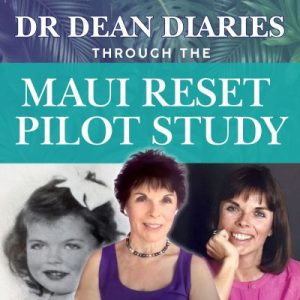
The Dr. Dean Diary Blogs trace the unplanned but perfect path to the 2026 Maui ReSet Pilot Study that confirms taking seven of my Foundational Formulas will extend your lifespan and healthspan.
Let’s continue with my journey.
If you read last week’s entry, you already know I grew up in a sugar-filled house in Dartmouth, Nova Scotia — with alternative medicine in my genes and ice cream in my bloodstream.
What comes next is the decade that actually decided everything – including the RnA Drops origin story, which started not in a laboratory but in Los Angeles, in 1971, years before I ever held a stethoscope.
Although it is not a straight line. But nothing worth anything ever is.
The Exploring Years
To begin, let me tell you about the year I ran away from home.
It was the fall of 1968. My high school guidance counselor — the memorable Miss Elliott — had already delivered her verdict on my future in 1967. I was to be, she announced, an executive secretary or a nurse – not a doctor. Not that I even had an inkling that I would ever become one. Additionally, this is from a woman watching me rotate the top marks with two other students, serve as Vice-President of the student council, and sit on several school committees. Even with all that high performance, back in the late 60s, being a doctor wasn’t seen as a potential profession for women.
So, following her guidance, I enrolled at Mount Allison University in New Brunswick – in Secretarial Science.
But here is what I’ll say in that program’s defense and in my defense: it taught me typing and shorthand. And I later used both every single day in medical school. Every lecture, every word, was captured in shorthand at full speed while my classmates scrambled in longhand. Miss Elliott may have been wrong about where I was headed but it worked out in the end – it always does.
After one year at university, my boyfriend and I had had enough, and we dropped out. We ran away — and instead of spending our small budget the way a lot of young people in the 1970s spent theirs, we put it toward an alternative health lifestyle. I explored alternative health conferences in Los Angeles. The early pioneers were on those stages — Adelle Davis, Paavo Airola, Dr. Jonathan Wright, Dr. Bernard Jensen, and Dr. Max Gerson.
These were the people asking the questions that conventional medicine was not. They were looking at food, at the terrain of the body, at what happens when you actually nourish the whole system instead of chasing symptoms. I was completely transformed. Later on, years later, I would meet Dr. Jonathan Wright and Charlotte Gerson in person. I even sat on the Board of the Gerson Institute in San Diego and gave her advice on taking magnesium!
Somewhere in all of that, I started saying — out of nowhere, with no clear plan to implement— that I wanted to do The Great Work.
I didn’t have a definition, yet. I just knew it was true.
Behind The RnA Drops Origin Story
In 1971, in Huntington Park, we met a man doing something quite remarkable.
He was making small water purifiers by fermenting grains. The purifiers were compact — roughly the size of ice cubes, cast in porous cement — and you placed them in your drinking water. We had read about his work back in Nova Scotia, as part of our interest in health, and when we met him in person, we were already believers. In the time – the next twenty-five years – we used them, we felt we were healthier. That we were aging more slowly. That something this formula was producing was doing what we had never seen a supplement do.
I want to be precise: that was our experience, our personal observation. But the idea — that clearing and even energizing water and perhaps making the mineral and nutrient content more available, and that this strange process could slow aging — intrigued me. It is the same thread I am still pulling on today. Fifty-five years later, it became the central question of the Maui ReSet Pilot Study during a time when aging and longevity were and are the hot topics in the alternative health world.
In 1993, when our American friend – the source of our RnA Drops – was dying, he unexpectedly gave me his formula saying that I was probably the best person to continue his work.
With a little tweaking over the decades that followed, the grains used to create the water purifier became the RnA Drops – the cornerstone of the RnA ReSet line. Every capsule or powder we make contains a dehydrated portion of that original formula. The RnA Drops origin story doesn’t begin in a lab or a boardroom. It begins in a Huntington Park cottage with a man who trusted a young woman with something he had spent his life building.
In 1972, back in Nova Scotia, I enrolled in Honors Biology, which meant four years instead of three. I thought ecology might be my path. To test that, I took a summer job with the Department of the Environment, traveling around the province with a mobile field unit testing water quality.
My coworkers trashed every place we were stationed. They had no concept of ecology whatsoever. It was both funny and completely disheartening.
The following summer, I did ocean sampling of Spirorbis – a cute little worm that lives in a tiny white shell. Not exactly a calling. But I loved being out in small boats along the Nova Scotian coastline, so I had no complaints about the worm that took me there.
I genuinely didn’t know what I was going to do with a biology degree. And then, one ordinary day in a lecture theater, everything changed.
The Decision
I was sitting in a biology class when two classmates came up to me with a question.
“Have you been accepted?” one of them asked.
I gave them my cheeky answer: “I feel pretty accepted, so what are you talking about?”
It turned out these two wet-behind-the-ears twenty-year-olds had just been accepted into medical school.
I was livid – these mutts were going to be doctors! That was crazy.
Because the whole time, I had been doing “The Great Work.” Reading Adelle Davis; baking my own bread; choking down nutritional yeast; and absorbing every shred of natural medicine literature I could get my hands on. And these two had never thought about health. I think they both had medical backgrounds and had probably been groomed from a young age to follow in the footsteps of their fathers and brothers… not their sisters.
I probably considered it for a day. Then I told my husband I thought I should apply to medicine. I went to the library and looked up the requirements. I had everything – except Physics 101 and Inorganic Chemistry. Nobody takes Inorganic Chemistry unless they are going into medicine.
I decided I was going into medicine.
The Miss Elliott Moment
Shortly after that, I walked into the Dean of Medicine’s office to pick up an application.
And I kid you not: seated in the Assistant Dean’s chair was Miss Diane Elliott.
My nemesis. The woman who had told me I should be an executive secretary.
In the spirit of Lucille Ball, I said: “Miss Elliott, you’ve got some ‘splaining to do!”
I told her I should be a doctor and I had most of the required courses. She said she was on the medical acceptance committee. And then she told me something I have never forgotten. The school was raising its female applicant quota from under twenty to thirty-three out of every one hundred students.
She thought I had a good shot.
Fate has a very specific sense of humor.
The Postcard with a P
Most students who want to become doctors have been planning it since childhood. From the age of ten, they chase top marks. By the time they sit for the Medical College Admission Test (MCAT), they understand exactly what is at stake.
As for me, I had applied to medicine somewhat the way I stumbled into everything else—sideways, quickly, and without fully grasping the weight of it until after the fact.
Fortunately, the test itself went well even though it was held in a huge, cold gymnasium. What I remember most, however, is how I found out I had passed.
Instead of a formal letter, they sent a postcard – a tiny postcard with my name on it and a small box in the top right-hand corner. Inside the box: one letter, “P.”
Naturally, I had to assume it meant I had Passed.
Once my P was confirmed, I was accepted on one condition: I had to earn passing grades in both Inorganic Chemistry and Physics 101 that semester. Meanwhile, to balance out the academic rigor, I audited a Science Fiction course at the same time.
Personally, I thought it was perfectly appropriate.
What Came Next
Finally, I had arrived, officially: against Miss Elliott’s original verdict; across a winding road of health conferences, Spirorbis boats, and a California meeting; and two twenty-year-olds who had no idea what they had set in motion.
When I walked into Medical School in the fall of 1974 as one of thirty-three women in a class of one hundred, it was the most that I had ever felt in the right place… and the wrong place at exactly the same time.
Although the RnA Drops origin story was already percolating in my pocket, The Great Work was still ahead.
Next week in the Dr. Dean Diaries: what happened on Day 2 of medical school — and why every nude female photograph in the building was gone by morning.
This content is for educational purposes only and discusses nutritional and lifestyle support for normal structure and function of the body. It is not intended to diagnose, treat, or cure disease. Consult a qualified healthcare professional for personal medical guidance.
👉 Learn more and become a member here:
https://drcarolyndean.com/wellness-courses/